I’m leaving the old data below but updated with information from the Lancet and Anaesthesia Guidelines
Codeine and breastfeeding
Retraction: Pharmacogenetics of morphine poisoning in a breastfed neonate of a codeine-prescribed mother Lancet nov 21 2026 https://www.thelancet.com/journals/lancet/article/PIIS0140-6736(26)02255-5/fulltext
Retraction: Pharmacogenetics of morphine poisoning in a breastfed neonate of a codeine-prescribed mother On Feb 3, 2026, The Lancet published an Expression of Concern1 for a 2006 Case Report by Gideon Koren and colleagues,2 having received new allegations of falsification of toxicological data, authorship issues, and ethical concerns. These new allegations were referred to the Research Integrity Office of The Hospital for Sick Children, Toronto, ON, Canada, for a new formal investigation. We have now received the outcome and conclusion of this investigation. The authorship issues and ethical concerns could not be fairly investigated as a meaningful participation of Gideon Koren was unlikely to be possible. On the allegation of omission of material toxicological data, including the infant’s blood codeine and acetaminophen concentrations and the qualitative 2184 identification of codeine in the infant’s stomach contents, the report concluded that this omission constitutes falsification. The omitted findings left readers without the information necessary to assess the publication’s conclusion. We are therefore now retracting this Case Report. The Editors of The Lancet The Lancet, London EC2Y 5AS, UK 1 The Editors of The Lancet. Expression of Concern: Pharmacogenetics of morphine poisoning in a breastfed neonate of a codeine-prescribed mother. Lancet 2026; 407: 659. 2 Koren G, Cairns J, Chitayat D, Gaedigk A, Leeder SJ. Pharmacogenetics of morphine poisoning in a breastfed neonate of a codeine-prescribed mother. Lancet 2006; 368: 704
https://associationofanaesthetists-publications.onlinelibrary.wiley.com/doi/full/10.1111/anae.70128
Opioid analgesics
Morphine: transferred to breastmilk in small amounts. It has an active metabolite (morphine-6-glucuronide) that is more potent than the parent drug. Morphine has been recommended as the opioid of choice if strong analgesia is required in patients who are breastfeeding [69]. Administration of a single dose of morphine to a patient who is breastfeeding would not be expected to cause detrimental effects to the child. There are limited studies of morphine patient-controlled analgesia following caesarean section. Transfer of morphine and morphine-6-glucuronide into breastmilk was low (< 48 ng.ml-1 and < 1084 ng.ml-1, respectively), and breastfed babies showed no neurodevelopmental delays on day 3 following birth [70]. If repeated doses of morphine are used, the child should be monitored for signs of sedation and respiratory depression. This may be more likely if there are also signs of excessive adverse effects in the patient.
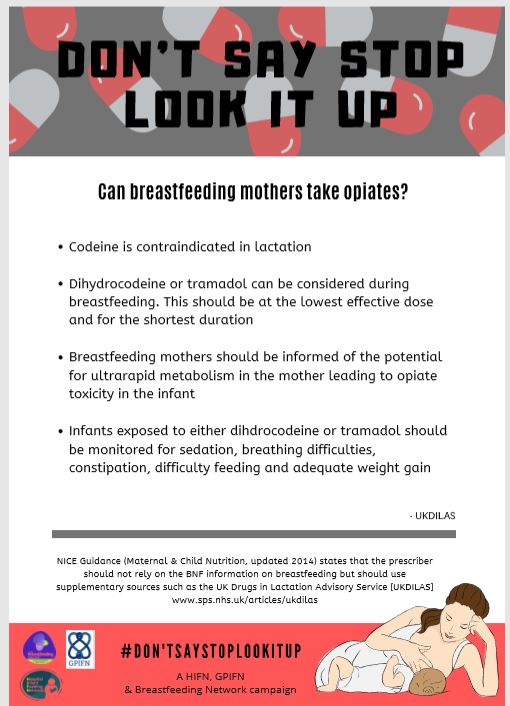
Codeine: half-life of 2.9 h, plasma protein binding 7% and a relative child dose 0.6%–8.1% [5]. Codeine is a prodrug, which is metabolised to the active drug morphine by the cytochrome P450 hepatic enzyme system isoenzyme CYP2D6. This enzyme has considerable genetic polymorphism. Patients who are poor metabolisers have little analgesic effect from codeine, whereas those who are ultrarapid metabolisers will have marked effects and adverse effects. There are large differences in the frequencies of variant alleles across ethnicities [71]. If a single dose of codeine is taken by a patient who is breastfeeding, there is no need to express and discard the milk. It may take 15 h for a normal metaboliser to have full clearance of a dose of codeine from the maternal plasma; however, ultrarapid metabolisers produce much higher concentrations of morphine in breastmilk, which in extreme cases may lead to severe neonatal depression and death in the child [72]. Families should be advised to observe the child for signs of excessive drowsiness and poor feeding.
It should be noted that the case report referenced above [72] has been questioned [73], with some publications based on this case retracted subsequently [74]. The original case report had been cited widely since its publication and its findings may have had a significant effect on the way that postpartum analgesic medication is prescribed, with one study from 2015 to 2016 showing that codeine was only prescribed to around 1% of patients in the postpartum period [75]. It has also influenced professional organisations and regulatory agencies; despite the concerns surrounding this case report, the US Food and Drug Administration (USFDA), European Medicines Agency and the UK Medicines and Healthcare Products Regulatory Agency (MHRA) still advise that patients who are breastfeeding should not take codeine [76-78].
Based on current international recommendations it is not possible to advocate use of codeine as a routine analgesic. There are alternatives which may be regarded as safer and more effective.
This is research at its worst, and PS: case reports are not research. We (researchers) are not all bad apples. Those of us who do this work are just as horrified as you.
This is why a case report (or a single study!) can’t be the end of the story. When one bad report is all we have to go on, it echoes. The fix is investing in lactation pharmacology research, so that we measure what gets into milk and what happens to the infants.
What hasn’t changed: opioids may sedate a breastfed infant, and the risk goes up with dose. Use the lowest dose for the shortest time and watch the baby. Even without this report, codeine isn’t ever my first choice for treating pain (there are a lot of better options).
Retraction: The Lancet, Vol 408, November 21, 2026.
Dihydrocodeine: has oral bioavailability of 21% due to substantial first pass metabolism, with a half-life of 3.3–4.5 h [79]. It is metabolised in the liver by CYP2D6 to dihydromorphine, which has potent analgesic activity. However, the CYP2D6 pathway only represents a minor route of metabolism, with other metabolic pathways being involved. The metabolism of dihydrocodeine is not affected by individual metabolic capacity as the analgesic effect is produced by the parent drug the analgesic effect appears to be mainly due to the parent compound [80]. Dihydrocodeine may be the preferred weak opioid for postoperative use in patients who are breastfeeding [81], because of its more predictable metabolism compared with codeine and wide experience of use after caesarean section, although the patient should be monitored for signs of significant adverse effects.
Tramadol: both parent drug and its active metabolite O-desmethyltramadol are excreted into breastmilk at low levels (relative child dose < 3%) [82]. There have been case reports of respiratory depression and death associated with the use of this medication. Despite a literature review finding no adverse events, the USFDA issued a statement in 2017 warning against taking tramadol while breastfeeding [76], citing similar potential risks to those seen with codeine ultrarapid metabolisers. The UKDILAS recommends that tramadol can be used short-term during breastfeeding with caution; however, the child should be observed for increased sleepiness, signs of respiratory depression, sedation and decreased alertness [83].
Oxycodone: has a metabolism that is similar to codeine: poor CYP2D6 metabolisers may have decreased clearance of oxycodone, and ultrarapid metabolisers higher concentrations of the more potent metabolite oxymorphone, leading to sedation. A breastfed child may receive >10% of a therapeutic dose of immediate release oxycodone [84]. For controlled release formulations, the estimated weight-adjusted child oxycodone dose is < 10% of the maternal dose [85]. Several case reports and studies have reported sedation, respiratory depression and difficulty feeding in children exposed to oxycodone via breastmilk, especially at doses > 30 mg per day [86]. As with any opioids, caution should be used when giving oxycodone as a single dose intra-operatively, and the child monitored for sedation after breastfeeding. Maternal excess effects may also feature. Repeated dosing of oxycodone should be avoided when breastfeeding.
It seems that more people ask about the use of codeine than any other drug. The changes in guidance following the MHRA report in 2013 and 2015 seem to cause much confusion. We need to be aware as mothers that if we take codeine and our babies become sleepy (sleep longer or more frequently) then this is a sign that we may have the metabolism that concentrates the drug in breastmilk and should stop taking the drug. It takes 15 hours to be clear from the system but unless the baby shows signs of breathing difficulties it isnt a reason to panic . If there are breathing difficulties medical help should be sought urgently.
The oral bio availability of dihydrocodeine is 20% due to substantial first pass metabolism. The half life is quoted as 3.5-5h (Martindale). The metabolism of dihydrocodeine is not affected by individual metabolic capacity as the analgesic effect is produced by the parent drug compared to codeine which is a pro drug. Bisson DL, Newell SD, Laxton C, on behalf of the Royal College of Obstetricians and Gynaecologists. Antenatal and Postnatal Analgesia. Scientific Impact Paper No. 59. BJOG 2019;126:e115–24.
Opioids should only be used if paracetamol plus ibuprofen/naproxen/diclofenac are providing insufficient pain relief or are contra indicated.
Dihydrocodeine has a cleaner metabolism and as such is preferred as the opiate painkiller (It is known as co-dydramol when combined with paracetamol) . This generally requires a prescription. In some areas codeine is still prescribed to breastfeeding mothers, in others it is totally forbidden. In this fact sheet I have tried to provide the full research history so that you can make an informed decision about what is right for you and your baby. We should also be alert to the fact that codeine is very addictive to us as adults so longterm use unless under medical supervision should be avoided