One of the questions that frustrates me is “Can I continue to breastfeed immediately after a VQ scan, they think I may have a clot on my lungs? I’ve been told I have to stop feeding for 12 hours”. Most of these mothers have very young babies – often under 2 weeks so to dump that precious milk for 12 hours is really tough. There hasnt been enough time to build up expressed milk so necessitates the use of formula and a very premature end, against mum’s wishes usually, to exclusive breastfeeding.
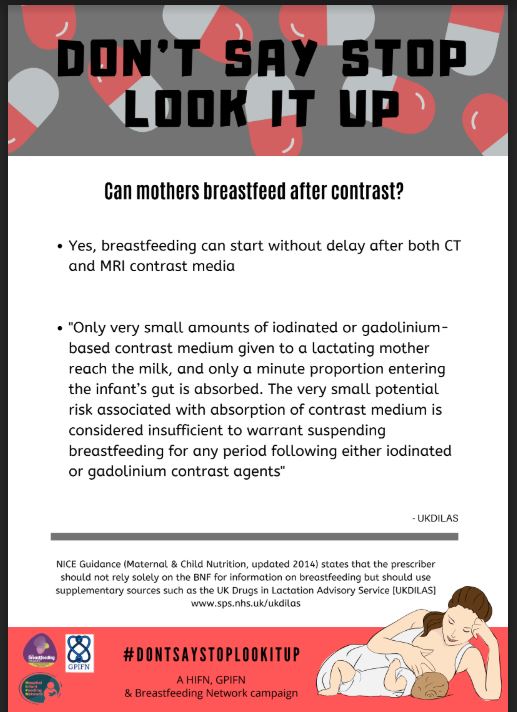
The evidence is really hard to find. One option is to request a CT scan after which breastfeeding can continue as normal. The #dontsaystoplookitup poster refers just to CT and MRI scans and not to VQ scans
This information is from my book “Why Mother’s Medication Matters”
You may need an X ray, CT scan with contrast (nor risk with breastfeeding) or ventilation perfusion scan. A pulmonary ventilation perfusion scan is actually two tests which are usually performed together. These tests use inhaled and injected radioactive material to measure breathing and circulation in all areas of the lungs. There is a small exposure of radiation from the radioisotope used in this scan. The risk to you of the radiation is about the same as having an x-ray. The radioisotopes used during scans are short-lived and leave the body quickly. However, because they may be passed into the breast milk it is recommended that you do not breastfeed for 7 hours. During this time you need to pump and dump your milk.
A VQ scan is carried out in two parts. In the first part, radioactive material is breathed in and pictures or images are taken to look at the airflow in the lungs. In the second part, a different radioactive material is injected into a vein in the arm, and more images taken to see the blood flow in the lungs. The advice is to stop breastfeeding for 24 hours but these pieces of information are available from
expert sources.
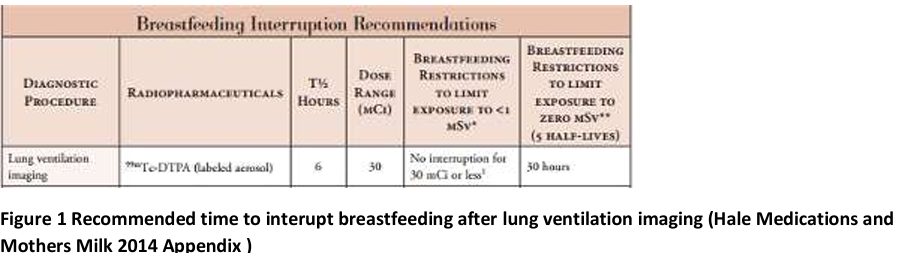
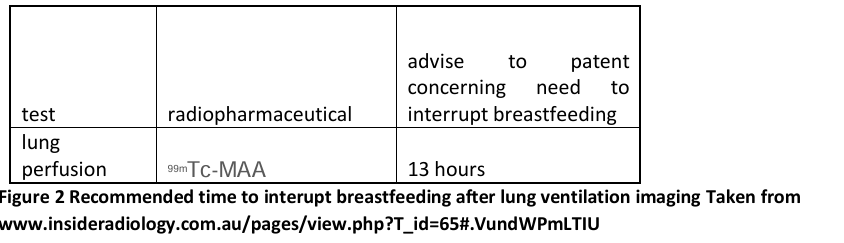
Whilst Lactmed states “Summary of Use during Lactation Technetium MAA: Information in this record refers to the use of technetium Tc 99m albumin aggregated (Tc 99m macro aggregated albumin; Tc 99m MAA) as a diagnostic agent. Breastfeeding should be interrupted for 12 to 12.6 hours after administration of Tc 99m albumin aggregated. During the period of interruption, the breasts should be emptied regularly and completely. If the mother has expressed and saved milk prior to the examination, she can feed it to the infant during the period of nursing interruption. The milk that is pumped by the mother during the time of breastfeeding interruption can either be discarded or stored refrigerated and given to the infant after 10 physical half-lives, or about 60 hours, have elapsed And Technetium DTPA: Information in this record refers to the use of technetium Tc 99m pentetate (Tc 99m-diethylenetriaminepentaacetic acid; Tc 99m DTPA) as a diagnostic agent. The United States
Nuclear Regulatory Commission states that breastfeeding need not be interrupted after
administration of Tc 99m DTPA in doses up to 1000 MBq (30 mCi) intravenously or by inhalation to a nursing mother. The International Commission on Radiological Protection also recommends that breastfeeding need not be interrupted after administration technetium Tc 99m pentetate. However, to follow the principle of keeping exposure “as low as reasonably achievable”, some experts recommend nursing the infant just before administration of the radiopharmaceutical and interrupting breastfeeding for 3 to 6 hours after the dose, then expressing the milk completely once and discarding it. If the mother has expressed and saved milk prior to the examination, she can feed it to the infant during the period of nursing interruption. Mothers need not refrain from close contact with their infants after usual clinical doses. 99mTc-diethylenetriaminepentaacetic acid (DTPA) is the most commonly used radiopharmaceutical in the aerosol whilst the radiopharmaceutical used for perfusion imaging is 99mTc-MAA (Parker 2012)
.
One local guideline recommends 7 hours, two others 12 hours whilst The Royal Australian and New Zealand College of Radiologists recommend 24 hours Confused? I am but what is clear is that 24 hours is not supported by the research evidence and information from the experts on radioactivity. I have included references for you to show clinicians rather than passing on any clear recommendation.
X rays and CT scans with or without contrast do not present a reason to interrupt breastfeeding and are the preferred options.